
A backyard renovation doesn’t fit in a month
Our spreadsheet always kept the backyard on its own tab. EvenHearth does the same thing, and calls it a venture.
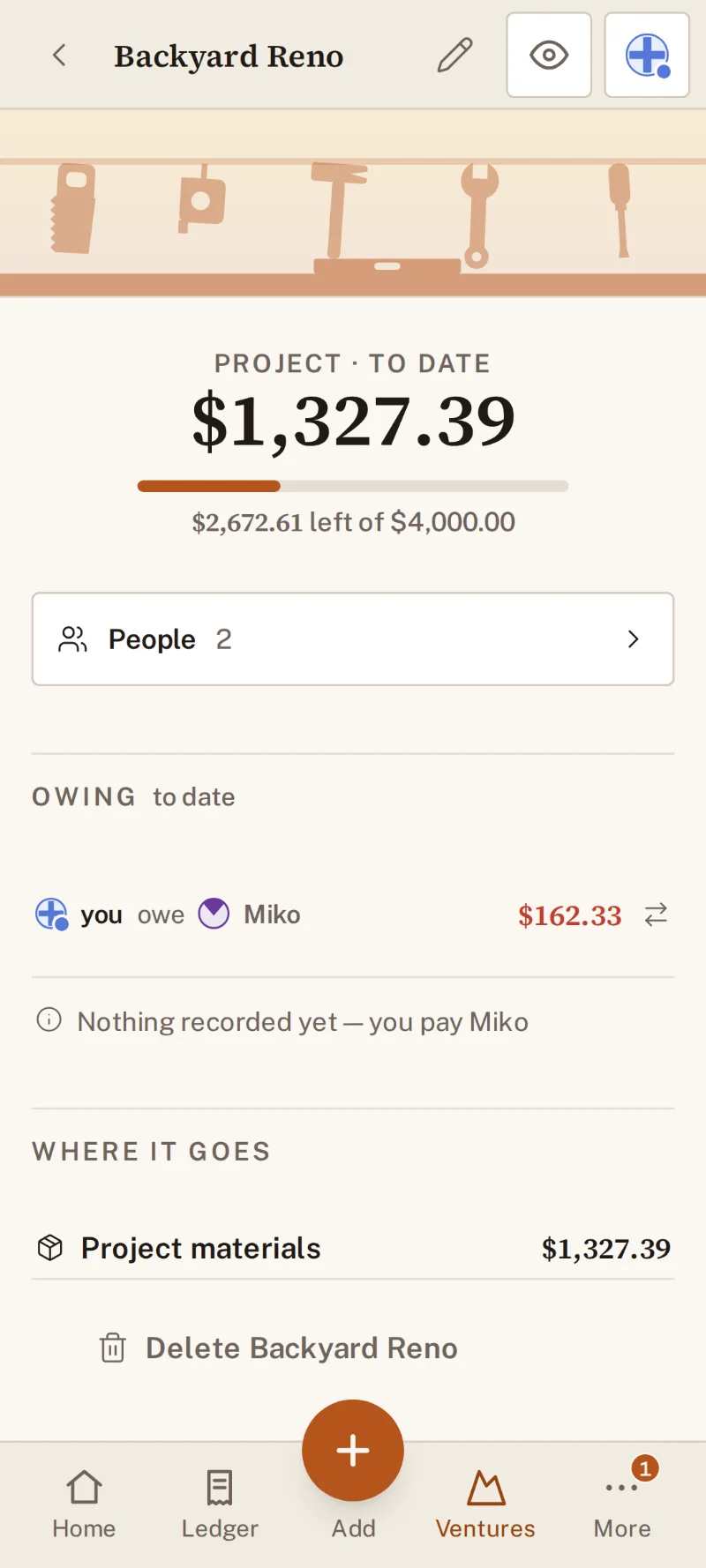
Our spreadsheet has a tab for every month, and one tab that doesn’t belong to any of them. It’s called “Backyard Reno”.
A project throws off a monthly budget in a particular way. Put a load of lumber on the September tab and September stops telling you anything useful. The pie chart that’s meant to show how the household lives turns into one huge slice. The month looks expensive, the next one looks cheap, and neither is true.
A project also has a different shape. It has a budget, a start and, sooner or later, an end. The question that matters isn’t “what did we spend in August?” It’s “how much of the backyard have we paid for, and how much is left?”
So the backyard got its own tab.
Ventures
EvenHearth keeps that idea and gives it a name. A venture is a trip or a project with its own people, its own budget, its own split and its own settlement.
When you add a purchase, you choose where it belongs: the household month, or a venture. Venture spending counts against the venture’s budget. The month’s shared total leaves it out, and shows separately how much went to ventures, so September still looks like September.
A project is work with a budget and an end: a renovation, a big repair, a new fence. As the receipts come in, you can see how much of the budget is spent and how much is left.
Trips come with other people
A long weekend with a friend adds a third person who’s paying for things. That person should see what the trip cost, and nothing about your groceries.
In EvenHearth, the friend joins the trip as a guest. They don’t need an account. They can add what they paid for and settle up at the end, and they see that one venture and nothing else of your household. Once a guest is on a trip, it splits evenly across everyone on it.
Settling twice
When a venture is done, you close it and settle it, separately from the month. The monthly settlement never includes a venture’s money. Closing the month doesn’t settle the trip, and closing the trip doesn’t touch the month.
That means squaring up twice. We think that’s right, because they’re two different questions: what the household owes itself this month, and what everyone owes each other for the thing you did together. When they’re mixed, a trip’s balance gets lost inside a month’s.
In the screens on this site, the sample household’s Backyard Reno is $1,327.39 into a $4,000 budget, and their friend Sam still owes $429.30 for Tofino.